
COQHCYT Opens Summer Course Registration at Quintana Roo's Four Planetariums
Quintana Roo's Council of Science and Technology is inviting children and teenagers to sign up for astronomy and science programs in Cancún, Chetumal, Cozumel, and Playa del Carmen, running July 20 through August 14.
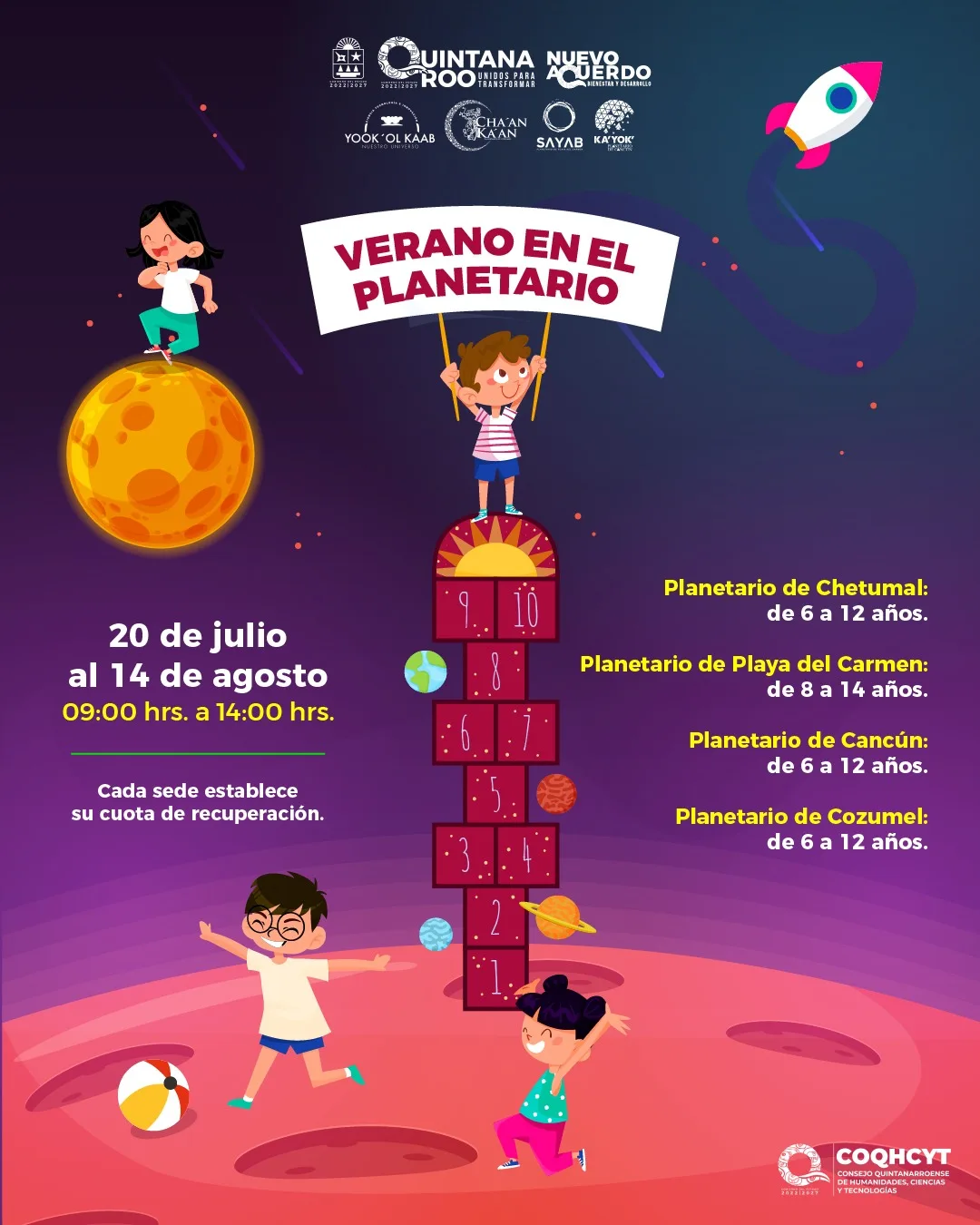
Quintana Roo's Council of Science and Technology (COQHCYT) has called on families across the state to register children and teenagers for summer courses at its network of four planetariums, running from July 20 through August 14, according to an official bulletin released by the state government. The program is timed to the school summer break and offers an educational option across the council's four locations.
Per the bulletin, each planetarium set its own fee and age range. In Cancún, the Ka'Yok' planetarium will admit children ages 6 to 12 for a full-course fee of 2,750 pesos, the highest rate in the network. In Chetumal, the Yook'ol Kaab planetarium serves the same age range for 2,000 pesos. In Cozumel, Cha'an Ka'an offers a full-course option at 2,000 pesos or a weekly option at 700 pesos, also for children ages 6 to 12. In Playa del Carmen, the Sayab planetarium is aimed at ages 8 to 14, charging 2,000 pesos for the full course or 750 pesos per week; that location also offers a 50% discount for public-school students and for a family's second enrolled sibling.
Cristopher Malpica Morales, COQHCYT's director general, led the announcement of the call for registration. The bulletin did not include an hour-by-hour activity schedule or the number of available spots at each site.
For families in Cancún, the Ka'Yok' planetarium is located on Avenida Politécnico Nacional s/n, at the corner of Avenida Kabah, in the Región 93 neighborhood, next to Parque Kabah. COQHCYT recommends confirming schedules, availability, and payment details directly with each site before attending, since the bulletin does not spell out those specifics. For Cancún, the listed contact channel is the official social media account @planetariokayok; families can also check the council's website, coqhcyt.qroo.gob.mx.
As a practical note for outdoor activities or travel between sites, COQHCYT suggests bringing water, a cap, and sunscreen, given the heat typical of July in the Mexican Caribbean.
With four active locations — Cancún, Chetumal, Cozumel, and Playa del Carmen — this year's call expands the state science council's summer offering to Quintana Roo's main urban centers, at a time when many families are looking for activities to fill the school break.
Related
City planning institute IMPLAN invites residents to ride on October 17 from City Hall for World Breast Cancer Day; health specialists will staff an information booth.
The bill now goes to the Senate, which has until Oct. 31. Taxpayers who use the program would have to pay their debt in a single payment before Jan. 1, 2028.
With this delivery, the land-regularization program has issued 2,102 deeds in Benito Juárez, according to the city.
The full Chamber upheld the non-resident fee set in committee, along with higher airspace, visa and railway charges. If you live in Mexico, you don't pay it.